Saturday, July 13, 2019

Scarjo Laments Politically Correct Casting: ‘I Should Be Allowed To Play Any Person’

Original post: LINK

In 2018, actress Scarlett Johansson faced a cavalcade of intense criticism from the Left for agreeing to play a transgender man in the movie "Rub & Tug." Eventually, and after enough backlash, she dropped the role entirely. Now she's lamenting how politically correct the casting process has become.

The Black Widow actress told As If magazine that she "should be allowed to play any person" she wants.
"You know, as an actor I should be allowed to play any person, or any tree, or any animal because that is my job and the requirements of my job," she said. "I feel like it’s a trend in my business and it needs to happen for various social reasons, yet there are times it does get uncomfortable when it affects the art because I feel art should be free of restrictions."
Johansson added that people should be allowed to have their own feelings and not be forced into conformity. "I think society would be more connected if we just allowed others to have their own feelings and not expect everyone to feel the way we do," she said.
The actress' statement to As If stands in stark contrast to her apologetic tone with Out magazine in 2018 upon her turning down the role in "Rub & Tug."
"I understand why many feel Dante ‘Tex’ Gill should be portrayed by a transgender person," she said at the time. "I’ve learned a lot from the community since making my first statement about my casting and realize it was insensitive. I am thankful that this casting debate, albeit controversial, has sparked a larger conversation about diversity and representation in film."
While Scarlett Johansson has been notoriously left-wing in her political advocacy, her tone in recent months has been slightly more nuanced. When speaking with Variety after the release of "Avengers: Endgame," Johansson even said that the Democratic Party is "broken in a lot of ways."
"Although now is certainly the time to back someone," she said. "I think I have to do a little soul searching. I think the Democratic Party is broken in a lot of ways and just damaged from these past several years. For me, if there was one candidate that I felt we could all unite behind, certainly that would be the candidate that I would back."
"They're out there, certainly. I mean it's been a strange few weeks," she continued. "I think it was clear and then it became sort of unclear."

When asked for her thoughts on former Vice President Joe Biden entering the race, Johansson simply said, "I don't know." As to whether or not allegations of past inappropriate touching will sink him, the actress also said, "I'm not sure."
Johansson saw her star power slightly slip in 2017 when both films in which she headlined – "Ghost in the Shell" and "Rough Night" – failed to attract audiences and critical acclaim. Leading up to the release of "Ghost in the Shell," Johansson actually said that audiences who disagree with her politics should stay home rather than a buy a ticket.
"If fighting, you know, for women’s rights, for women’s reproductive rights, and you know, in support of Planned Parenthood, if that’s going to, you know, mean that some people don’t want to buy a ticket to see 'Ghost in the Shell,' then … I’m OK with that," she told "Good Morning America."
www.SunServe.org | (954) 764-5150 | info@sunserve.org | Social Media Admin

Chicago Trans Power Couple Announce Pregnancy

Original post: LINK


Precious and Myles Brady Davis — known by some from their appearance on Say Yes to the Dress — will welcome their first child in the winter.


Trans couple Precious and Myles Brady Davis, influential leaders in the Chicago LGBTQ community, announced they're expecting a baby in the winter.
Myles, who identifies as two-spirit and trans masculine, underwent fertility treatments with the support of Precious, a queer biracial trans woman of color.
“Our love has brought us to this place and space where growing our family is now a priority… There have been many tears through our two year journey, but now we are celebrating a moment of triumph,” Precious and Myles said in an exclusive statement to The Advocate.
Myles Brady Davis is the director of communications at Equality Illinois and is a civil rights activist. He has supported various LGBTQ organizations, including Pride Action Tank, Trans Lifeline, and Miley Cyrus’s Happy Hippie Foundation. Precious Brady Davis is the Central Region communications manager at Sierra Club and is a diversity advocate and public speaker. Also passionate about LGBT youth, for three years she served as the youth outreach coordinator at Center on Halsted; she used her tenure to launch and coordinate a $1.6 million Centers for Disease Control grant for HIV prevention, which provided health services to over 3,000 LGBTQ POC youth.
The Brady Davises were the first trans couple to be featured on TLC’s popular reality show Say Yes to the Dress and were married at the Rockefeller Chapel in Chicago. They were also invited to meet President Obama during the White House LGBTQ Pride reception in 2016
“It was daunting as a Trans couple navigating the world of fertility and we relate to those who struggle to conceive,” the couple added in their statement. “We hope once again that through sharing our story individuals are inspired to see that all kinds of families exist in our world and should be celebrated.” 


www.SunServe.org | (954) 764-5150 | info@sunserve.org | Social Media Admin

Laverne Cox: 'Immigration Is an LGBTQ Issue

Original post: LINK

The trans activist says immigration and LGBTQ rights are all connected, and we need to stand up for migrants and asylum-seekers.

As WorldPride brings millions of queer folks and their allies to New York City in the ongoing fight for equality, LGBTQ activists are calling for more support for asylum-seekers. 
This week, Marriott International made a landmark donation of $100,000 to Immigration Equality to support its critical work on behalf of LGBTQ and HIV-positive asylum-seekers fleeing persecution in their countries of origin. The donation is the largest corporate gift the organization has ever received. 
Each year, Immigration Equality provides advice and legal services to thousands of LGBTQ and HIV-positive immigrants seeking refuge, fair treatment, and freedom in the United States. For trans activists like Laverne Cox, who partnered with Marriott for its #LoveTravels campaign, highlighting the importance of inclusion and human rights across the world, it’s a discussion that’s overdue. 
“It’s such an emotional issue right now for the entire country because of what’s happening at the border,” Cox tells The Advocate at Marriott’s Beyond Barriers event in New York, which celebrated Immigration Equality and VideoOut, a video project that travels the country to amplify voices of LGBTQ people. 
“Immigration is [also] an LGBTQ issue." Cox continues. “We are having a conversation about immigration now, but that is not divorced from LGBTQ rights. That’s a global conversation. These conversations are all intersecting. It’s all connected.” 
Cox says that while trans visibility has grown tremendously in the last few years — with her groundbreaking role in Orange Is the New Black as well as shows like Transparent and Pose — we must also remember that trans women of color are being murdered at an alarming rate. As the Supreme Court is preparing to hear arguments about whether the Civil Rights Act of 1964 protects against discrimination based on gender identity, activists like Cox are making sure that Americans pay attention. 
“It’s probably a reaction to [trans] visibility,” she says of anti-trans rhetoric and policies. “It’s a reaction to the world changing because trans people have always been here — but we’re no longer in the margins. We are no longer relegated to exist just at nighttime and in the shadows. We have come into the light, and the world is trying to figure out how to reconcile us coming into the light, and wanting and needing a job.”
Visibility is the key to instilling empathy, adds activist and Queer Eye star Karamo Brown (pictured above), who also partnered up with Marriott for its #LoveTravels campaign. 
“I spend a lot of time on the Hill, and yes, I’m there because I’m lobbying for certain policies but it’s also just to say, ‘Meet me. I’m a Black man. I’m a gay man. I’m a father. Understand what my experience is like,’” Brown tells The Advocate.
Brown continues, "When you think about immigration you don’t think about the intersection of LGBTQIA people. People think of heterosexual families — mama and father and children. But within those families are LGBTQIA people, and not only are they fearing for there lives because they’re asylum-seekers, but there's this added level of When I do find safety, am I still going to be safe if I live my truth? Having campaigns like #LoveTravels helps that conversation because it helps you realize it’s not just families [seeking asylum]. It’s people who are traveling this world who need love and we need to give it to them." 
Corporate responsibility plays a major role as well. “What corporate America can do is have policies, to continue to reach out to various communities and let the world know that discrimination is not OK in their organizations,” Cox explains. “We have philanthropy and we have the incredible work organizations like Marriott do year-round … but we need policies in place.” 
www.SunServe.org | (954) 764-5150 | info@sunserve.org | Social Media Admin

House OK's Defense Funding Bill That Would Undo Trans Military Ban

Original post: LINK

www.SunServe.org | (954) 764-5150 | info@sunserve.org | Social Media Admin

Sunday, July 7, 2019

Social media has become a space where my own family and friends have turned into censors

Original post: NYT

By Richard Akuson
Mr. Akuson is a writer and queer rights activist from Nigeria.

On the quiet, promising first morning of June, I received a text message from my brother in Abuja, Nigeria. “Please, refrain from all these shameful acts,” he wrote. “Everyone is tired of you. Mummy is crying, Daddy is crying. If you don’t value relationships, we do!”

My brother had written after I had posted a picture on Facebook that showed me hugging a male friend. A mixture of anger, sadness and fatigue erupted in my body. “Block me if you are tired of my shameful acts,” I replied. “I won’t be the first or last person to be rejected by his family.”

I had the audacity to start a queer publication in Nigeria and was disowned by my country as a gay man, writer and activist. After a vicious homophobic attack in Akwanga, my hometown in central Nigeria, I moved to the United States and sought asylum here in the summer of 2018.

In a certain public rendering I could come across as a brave activist. But I have lived with intense private pain and discomfort after homophobic shaming from people like my own brother.

Social media can be a delightful way to connect with loved ones far away, but for me it has also become a space where my own family and friends have turned into censors, distorting my life, denigrating my being gay from thousands of miles away.

In Nigeria, I lived with the knowledge that my secret life as a gay man would eventually crumble under the weight of parental expectations. I could see clearly how it would pan out: After turning 30, I would have to marry a woman who might know I am gay but would prefer marrying me to being unmarried at a certain age. We would have three children in quick succession, as procreation is a duty I would be expected to fulfill promptly, duty being the bedrock of familial relationships.

My wife and I would suffer dutifully and receive the blessings of our parents. On seeing my wife and me in matching outfits, my father’s expressionless face would break into a rare, full smile. He would present us to his friends and colleagues at parties. My mother would carry around my children and make her friends, whose children were yet to bear them grandchildren, look on in envy.

But I walked out the door. I chose safety and freedom over years of pain and trauma that would come with such societal and parental approval. In Washington, where I live on the little that is left of my savings, the homophobia of my home and family follows me through social media, through emails and text messages.

There are days when I forget I am gay; those days are my happiest. I hang out with friends, not as a gay man hanging out with other gay men, but as friends having a good time. I return to my apartment with beautiful pictures in my phone.

Yet when I am about to post my pictures on social media, I examine them through the searching eyes of my staunchly evangelical Christian parents, through the prying eyes of my childhood friends who still remember me as the boy who would recite chapters of the Bible. I swipe through my pictures. “This is very gay!” “This is super gay!” “This is quite gay!” I judge my own images and delete the pictures. I am my own censor.

A few days after the exchange with my brother, a cousin sent me a message: “Jesus loves you, bro! Come back to him. He is ready to forgive you and take you back as his lovely child.”

I climbed back in bed and rolled myself into a ball as my heart sank into the hollow of my gut. My stomach gave a loud, nervous growl. I longed for death. These messages pull me back to the existential orbit I am always trying to escape. I ask myself, “Is this really worth losing loved ones over? ”

I should relish the freedom America offers me, but it feels like I am running in the middle of a busy highway or breathing under water. Hiding in the closet is all I have known.

Some days ago, I was at a pride event for gay Africans in Washington, in a West African basement restaurant. I was chatting with a few Nigerians when a charming photographer raised his camera toward us. They instinctively ducked as if dodging a bullet. “You can never tell where those pictures will end up,” someone said. I nodded in agreement.

We are gay men ostensibly living openly gay lives in the United States. But we live with the fear of our families back in Nigeria ever knowing that we are gay or, in my case, that I find even the slightest peace or comfort in it. I declined invitations to the D.C. Black Pride events for fear of being photographed.

I fail to live fully for the fear of getting into yet another fight with my parents. I dread the phone calls where they tell me how utterly ashamed and disappointed they are. After calls like that, I hang up. I hate myself and wish that I didn’t have to be gay, that it didn’t hurt so much.

The greatest pain is the constant fear of losing the people I love the most for a life that holds no promise of happiness. I’ve heard there is a beautiful, easy side to being gay, to loving another man somewhere along the journey. I know Pride is a celebration of this and much more, and for many others, it is a celebration of their own journeys to genuine pride in who they are.

Perhaps in another life, I would wear a floor-length, sparkly, rainbow-colored dress and the most elaborate synthetic neon wig, paint my lips red, wear big, false lashes and lock hands with the rest of my community in celebration.

But in this life, I am a traumatized Nigerian torn between the duty of family and living an openly gay life. I am a coward who gets mistaken for a hero. Pride is a luxury I cannot afford, yet.

Richard Akuson is a Nigerian lawyer and activist.

The Times is committed to publishing a diversity of letters to the editor. We’d like to hear what you think about this or any of our articles. Here are some tips. And here’s our email: letters@nytimes.com.

Follow The New York Times Opinion section on Facebook, Twitter (@NYTopinion) and Instagram.

A version of this article appears in print on July 7, 2019, on Page SR7 of the New York edition with the headline: ‘This Is Quite Gay!’. Order Reprints | Today’s Paper | Subscribe


www.SunServe.org | (954) 764-5150 | info@sunserve.org | Social Media Admin

Friday, July 5, 2019

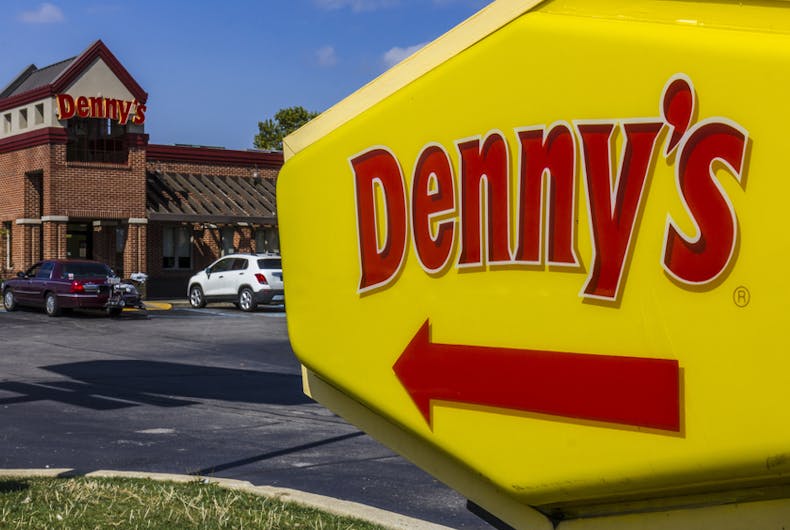
Denny’s stood up for a trans woman who was arrested after she used the bathroom

Original post: LGBTQNATION

A customer at a Shelby, North Carolina, Denny’s called police to report a 22-year-old trans woman who used the same bathroom as his wife.
When police arrived, they said she hadn’t broken any laws. In response to the incident, the national restaurant chain announced that all of its bathrooms are open to trans people, regardless of local laws or biases.
After the man called the cops on the trans woman, the woman and the man got into a dispute which gradually escalated, leading the woman to allegedly spit at the man and his family. The woman was charged with disorderly conduct.
In a company statement, Denny’s said that it “does not tolerate discrimination of any kind” and expects customers to treat people equally, according to WSOCTV.
North Carolina became infamous in 2016 for signing HB2, a law which banned trans people from using the bathroom matching their gender identity. The state lost an estimated $560 million in revenue from businesses and visitors that refused to visit after HB2 was passed; the law also contributed to the re-election loss of then-governor Republican Pat McCrory.
But even when the law was repealed in January 2017, it didn’t grant bathroom access to trans people. Rather, it left bathroom regulation up to state lawmakers, essentially returning North Carolina to the status quo before its city of Charlotte passed a 2016 ordinance allowing trans people to use restrooms matching their gender identity.
So while Denny’s allows trans people to use the restrooms best matching their identities, trans people living in North Carolina may be less sure whether the law approves or disapproves of their right to use the restroom in peace. Few likely realize that a federal court ruled that the state can’t legally ban trans bathroom users.
However, the HB2 repeal said that cities and the state can’t pass any pro-trans bathroom ordinances until December 1, 2020, essentially leaving trans people subject to the court’s interpretation of current state law rather than giving them an ironclad law that unequivocally states their right to public accommodations.

www.SunServe.org | (954) 764-5150 | info@sunserve.org | Social Media Admin

Sunday, June 30, 2019

So I came out during my valedictorian speech

From Twitter: @maasonbleu

So I came out during my valedictorian speech. It was definitely the scariest thing I’ve ever done but the reaction was amazing. Thank you to everyone who supported me! #Pride2019 #LGBTQ 

LINK TO TWITTER VIDEO


The overarching theme of the speech was about being proud (it is pride month) so I decided that I couldn’t tell people to be proud of who they are when I was in hiding for so long. Anyways, I did this not only for me but for anyone else who has struggled being closeted.

If anyone wants to talk to me about anything my DMs are open. I know what it feels like to be closeted and think that no one else is like you but trust me you’re not alone. I played basketball, baseball, football, and am pretty masc + black. I felt like a total outcast.

With that being said, you’re not alone. Reach out to me or anyone else you trust. I’ll definitely be willing to talk to anyone. ♥️ thank you so much and happy pride! - Mason @maasonbleu 6/29/2019

www.SunServe.org | (954) 764-5150 | info@sunserve.org | Social Media Admin

Coming Together for Our Community: A Heartwarming Back-to-School Backpack Drive

As summer begins to wind down and the anticipation of a new school year starts to build, the importance of preparation and support for our c...